For our corporate video unit, we had to work alongside the "James Paget University Hospital" to produce a promotional video which would encourage junior staff to consider working for this local hospital. During the early stages we met up with a few people from the Paget to discuss ideas for the video, my group pitched our idea infront of them to see what they think about it and if it would actually be successful. After the pitching of ideas we then had a chance to negotiate different things which would make the video better, a good thing about working with them was that we had a lot of input into the project, they didn't cut off any of our ideas and we didn't have to stick to theirs. There was a lot of freedom in terms of what we planned, filmed and edited, nothing was restricted.
In regards to the brief I worked to, the information given was quite vague of things they wanted us to include and shots they wanted us to feature. We saw this as a problem early on, as at its worst we could produce something they didn't really have in mind and as a result turn our work down. This was resolved however with a chance to meet with them and discuss the brief in person. I would say there was a fairly high degree of discretion with my brief, but unfortunately this isn't the case with every corporate project. Discretion can be very limited given you no control over what happens with the video.
In terms of legal, ethical, regulatory constraints we, as a group, faced quite a lot, taking into account that we had to film in a public hospital. Down to legal issues we weren't allowed to wonder into certain wards of the building to capture footage, we had to be escorted around the hospital by one of the supervisor staff members to ensure we were only filming things that were allowed to be filmed. We would have been able to film specific patients if we had them sign a talent release to prove permission to be on camera, however as this would have taken to much time which we didn't have, we decided not to bother and only record clips of people that were in groups or film areas which had no people. Fortunately no other issues arised, but they do happen, such as ethical issues. Race, culture religion and colour of your skin all has to be taken into account when producing a corporate video, you need to respect everyone and not discriminate against or be racist towards any cultural or ethnic groups.
After creating and sending the "James Paget" our first rendered drafts, we were sent back a considerable amount of feedback which included essential things to change and areas of improvement. Normally this would be okay, we would correct the things we needed to and send them back a second draft. However, they sent us amendments that were to be made on things that were set-up and asked by them. My group was arranged an interview with a lead doctor of the children's department "Children's Cove, we asked questions and recorded the whole thing to fit into our video about AHP's. Part of the feedback mentioned that we used the wrong doctor in our video as he doesn't come under AHP's, even though he was the doctor we were set up with by the staff. Working an negotiating with clients can be very tough, as proven, but mostly all have a good outcome. After mentioning that these faults were down to the poor management of the staff at the Paget we were able to keep parts that were said to be corrected and just tweak certain things like audio and lighting, other than that we were able to keep a good final render.
Other than amendments to the actual video, is it possible that there may have to be amendments to the budget, fees and many other things to do with the film. It may be noticeable that during your time on the production you see that you are needing more money that you actually planned for, it would then be time to contact the client to discuss the issues and to come to a conclusion. It might even be possible that you don't need to even make any amendments to the first render, in which case it is good to go, and send forward to the company to publish. Although it's very rare, it can happen.
Opportunities
People/companies can have many reasons to respond to media briefs depending on the situation. You may want to build up a portfolio which shows your work with different clients, or maybe you are entering a competition which involves you meeting a brief set by a specific or general client. Obviously money is a big part of competitions which a massive reason why people and companies enter, money can help with personal issues or expanding there business which can result in working for more professional companies and clients. This is also an amazing way to gain experience in the industry as you will have the opportunity to meet new people, gain contacts and gather a stronger understanding of how the trade works.
When working on the corporate video for JPH, there were many times we, as a group were able to self-develop skills and techniques to help remain patient yet professional at the same time. Working with the staff wasn't exactly easy, meaning we had to cope with cancellations they made at last minute but remain calm and show our understanding why they couldn't have us film. There were times where all of us got very annoyed due to JPH staff meeting us at a designated meeting point 1 hour later than they should have, on several occasions. But as said before, it is all about remaining patient as this opportunity is not just for them, but it is for us aswell; Course unit, and experience.
During my time working on the brief for JPH I learnt multiple skills that would indeed benefit me if I choose to have a career in the film industry in the future. Working with audio equipment for interviews is something I have improved on a lot. With past projects I haven't been too great at recording and editing sound, however when shooting interviews with members of the JPH I was able manipulate settings on the audio device to achieve the best sound possible with that piece of equipment. Teamwork is a huge skill that I have developed throughout my time doing this course but most doing this specific unit, everything from start to finish involved working with your team. We had to brainstorm ideas together, pitch together, record together and edit together. We also had to resolve problems together, such as corrupt files that didn't record properly so we had to re-shoot, 1 member being off sick so we had to split ourselves to take up multiple roles.
This takes me into the next subject of having to multi-skill to allow your group to achieve the best. Although everyone may only have one important skill that they can contribute to the team, you may have multiple which will help benefit team in certain areas. For example; You could have team members that are great at storyboarding and pitching to a client but they are weak and recording and editing footage. You on the other hand can do both them things to a really high expectation. It is always useful to have multiple skills to offer to your team just incase you may ever be in need of them. When working on my corporate video I was selected as the editor who would combine all footage, edit audio and apply text and credits. It so happened that on one shooting day our main camera man was off sick and I had to replace him using my maximum knowledge to shoot the best scenes possible to my ability.
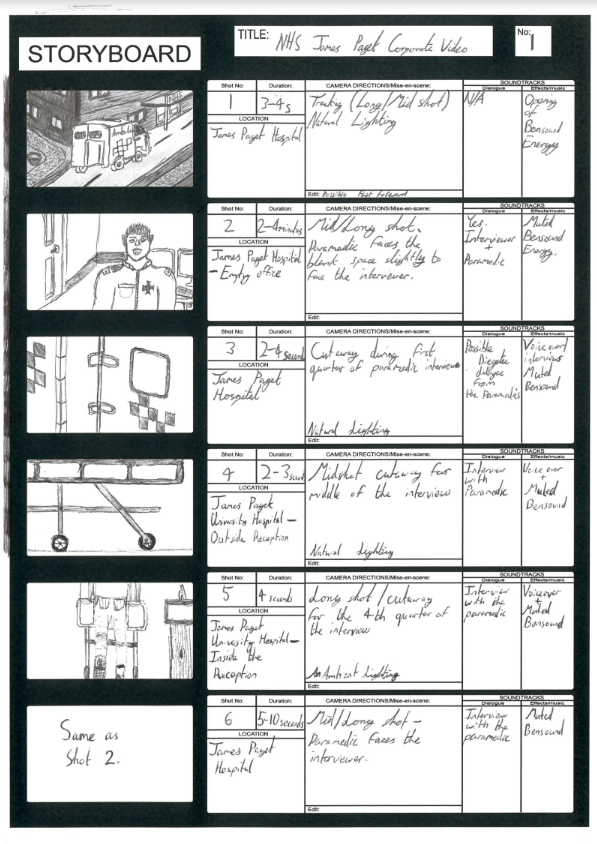
It is fair to say that all 4 of us in my group made a considerable amount of contributions to the project which is what made it so successful in the end. The main contributions I made was the overall narrative plan, all scenes from start to finish and how they would work;
Title>Interview-Cutaways>transition> and repeat*
I also came up with the idea to add motion tracked text for each title to make the video seems more professional when shown for a recruitment video for the NHS. I originally planned to use 3D text but with the time cap we had after all cancellations and delays, I only had to time to track and add 2D text to the footage. Another small thing I came up with was to create a google drive folder in which we could all access to find every piece of pre-production paperwork. This made it extremely easy for us when it came to posting it, because as soon as someone would finished some paperwork they would upload it and everyone can download it and post it themselves to their own blog. Just a small idea that worked very well for us all, saved everyone emailing each other or printing things out and all the team scanning sheets onto the computer.
Corporate video is an umbrella term used to define all video communications used for internal or external corporate messaging. One way that corporate video can be contrasted from traditional video advertising is the target audience. Corporate video is often aimed at a specific audience rather than the general public. A corporate video might be created to present financial results to stakeholders or to highlight a new idea within the company. Corporate videos may also include employee training videos and promotional videos for new product lines or services, there are many, many more types of corporate video however these are the most common. Corporate video companies face a lot of obstacles to create a successful production. Although watching videos online made by these companies may seem like a walk in the park, the chances that certain issues came into play are very high. Obviously not every production involves serious legal issues to overcome, however it is always best that you are sure everything sticks to the legal criteria of corporate video allowing your current/future productions to be viable and able to be viewed by the public. I will begin to discuss all of the legal and ethical issues that corporate video companies have to face when producing content for their clients.
Copyright issues is a main focus when producing corporate videos, copyright protects written, musical, artistic and theatrical works. Also film, book layouts, broadcasts and audio. Databases and software can also be copyrighted because they can be classed as literary works. It is a widely held misunderstanding that works on the Internet are not covered by copyright and as a result can be used freely. Copyright law applies to online material just as it does to offline material, assuming the conditions for copyright protection are met. Video companies can get into a lot of trouble for producing videos that include copyrighted material, so much so, that they can potential get taken down from the eye of the public and even taken to court in some serious cases. In order to have a successful claim for copyright content you must be able to prove: you are the owner of a valid copyright in the work, or that you have had legal access to the copyrighted content, either through payment or other forms legality. Dragonfly is a corporate video company that are extremely popular within the UK, an example of legal copyright proven in one of their productions is "Royal Holloway - Dance - v1". The example is the soundtrack, they have used either their own produced soundtrack, recorded and edited by themselves or used royalty free music from the internet. either way this is perfectly legal and allows them to feature it in their video. If however, it wasn't their own material, they would have had to claim permission from the owner or would have had to face issues with the law for having illegal use of material.
Privacy is an important part in the media industry and especially corporate video companies. Producers must make sure that they do not interfere with peoples personal lives and not to broadcast any material that the persons do not approve of. For example if you were shooting a scene in a hospital and one of the patients personal documents were on show, people who watch the video will find out information which they are not meant too. For these reasons footage has to be checked through thoroughly just incase there are anythings hiding which may reveal someones personal identity. Because corporate video productions are normally for organisations, privacy is a key thing to take care of during filming as it normally covers a more people than just one. There may be people in your specific scene that may not actually want to be featured, this is an invasion of privacy and will lead to you having to re-shoot without them in it. Everyone in your scene/film will have to have talent releases to prove they are okay with being in the production, unless you are filming a massive crowd of people it is okay, because having 1,000's of people sign a form for you will be super difficult.
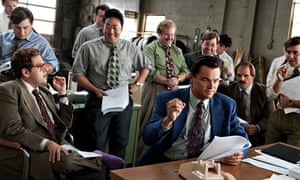
Defamation laws vary between different countries but usually concern content that damages the reputation of another person or corporate video company in this case. Although the meaning of defamation varies around the world, generally, defamation is any incorrect statement that is harmful to someone's reputation or causes someone to be dodged or avoided. Companies take into account the problems and issues they face with this process as in some cases, it can require a court order. For a defamation blocking request to be successfully processed, the claim needs to be specific and strongly supported. For example, it needs to explain why you believe that the statements are untrue and how it damages your reputation. However this should never have to be taken forward if you stick to the legal guidelines and follow the rules properly. In some cases, corporate video companies willingly remove harmful content. Because obtaining a court order can be costly and time-consuming. Normally if someone does submit a defamation complaint against you, they will do it directly instead of contacting someone else about it. A perfect example of a complaint in the industry is for the Wolf of Wall Street studio, a stockbroker who worked at the brokerage depicted in Martin Scorsese's The Wolf of Wall Street filed a £15million lawsuit against the producers of the Oscar-nominated black comedy for allegedly portraying him as a depraved criminal with an appetite for drugs and sex.
Fair Use is used as a defense to Copyright Infringement claims. Usable on a case-by-case basis of alleged infringement to determine if infringement actually occurred. This is slightly different to Copyright as Fair Use gives you exceptions to use certain material where as Copyright just tells you what you can't do. It is complicated and only applies absolutely on a case-by-case basis. Basically, it allows exceptions to be able to reproduce part of a work, for purposes of criticism, comment, news reporting, teaching and research etc. Parodies are often considered part of criticism. When producing a corporate video you need to be careful when using materials from different sources, it is more than likely you will want to use music someone else has created or include footage from the business or event you are promoting. If so, checking the Fair Use "rules" for the owners material is essential as you may be sued if using them without going by their guidelines. This video example from YouTube combines many different pieces of music form different owners, classing it as fair use material. In the description, the sources are clearly stated and guidelines have been followed allowing this person to use the numerous owners content.
Dealing with Ethical issues is very important within corporate videos as the video producers have to consider race, gender and religion. Race is what country, culture and background you come from and what colour you skin is. Someone’s race is considered to be what ethnic group they fall under. Most ethnic groups usually have the same religion, heritage or language/dialect, or if not the same very similar. In basic terms race is a classification system used to put human beings in to large and distinct sectors or groups. So in corporate films, producers or yourself have to try their best to not discriminate against or be racist to any cultural or ethnic groups. For example they need to appeal and respect everyone, so no one is harmed or offended by what is in the video i.e including mixed races and not singling anyone out in particular. Also you want to make sure your product, company or whatever it is applies to gays, straights, females and males, then you get as many employees as possible or as many sells of a product as possible. Like before, don't single out any particular group, including a mixture will make you much more successful. This corporate video is a great example:
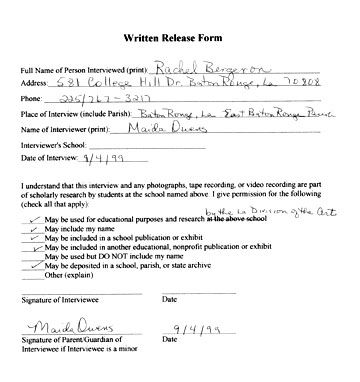
Before shooting a video it is really important that you have all released signed for the production (Materials, talent, location). It will do more harm to not have a signed release when you need one, than to have one that you do not need., better to be safe than sorry. Always have anyone appearing on camera in your video sign a release form prior to shooting. The release form will protect you against legal issues and gives you permission to use the video of the person for commercial and non-commercial purposes. If a person is part of a crowd of 4 or more people it is most likely you wont need them to sign a release, as the camera won't specifically be focused on them. However if you feel like they appear more frequent than others in the crowd you may want them to, to settle your mind and ensure you are fully protected. Whenever a film is being shot outside a studio, the producer may need to obtain one or more location releases from the owners of the property where filming takes place to prevent any illegal actions to be taken ahead by owners of private land. If you are shooting in a park, on public land, or in a street you should get permission from the local council. Even though these are public spaces, the council can still charge you certain amounts so it is best to check just incase you get into trouble. Like before, it is best to be safe than sorry.
The technology you use for your production is something worth
thinking about before you go ahead and start shooting. We use this word to describe all the electronical equipment and software that is used during a production. Every day, more and more companies are balancing the issues of technology with the right to privacy, information, and security. Because newer technology is more expensive it requires a higher budget and because you want to provide the best video possible for the consumer you need to obtain the best you can. the variation of technology you have will depend on whether you can expand your corporate company to do larger projects or just different types in general, like animation as well as IRL footage. This will make your company appeal to more people as you would be offering more services. But because other companies will have the same idea, your competition will increase making it harder for you. Offering something innovative will make you stand out from other standard corporate video companies. The Black Magic 4K Production camera is something that is used by a lot of corporate video companies, this is what you would call a high end camera as you would need a high budget (£2,000 for camera) and would be able to shoot very good quality videos. As said before this camera does shoot in 4K resolution, meaning crystal clear visuals, Touchscreen feature, standard mono microphone and up to 1.5 hours battery life per charge. although this is an excellent production camera, there may be shots that require some other camera to be used. for example if you need night shots or another specific camera that would be perfect for what you need. The Canon 750D's are also great cameras as they are very lightweight, great quality and affordable for low budget companies and producers. They also have lots of peripherals like lenses and battery packs which makes the camera even better to take filming.
Aside from cameras, lighting and audio equipment is another essential part of production, the room may be too dark, built-in camera microphone may include too much background noise or static. I could list all the different types of lighting equipment but I would be here ages, the most common type of lighting that can be useful in all sorts of different occasions is "Soft Box Lighting". You are able to mount these box lights onto a stand to rotate and adjust to get the exact lighting you desire. With many you can light a whole room, with 1 you can create a cool spotlight effect on the subject or environment, these light are really so useful for any situation. As well as there brilliant use, the price is also very affordable for low budget productions, or even high budget depending on what you need it for. They range from around £10 all the way to around £100. These are probably one of the most cheapest types of light you can buy which is why most corporate companies use them. As for audio recording, there is not really any exact model or make corporate video makers commonly use, this is because there are a whole range of sound equipment that sound almost the same and are the same to use in terms of complexity and easy to learn how to use. The main mics we use and the mic we used for a James Paget AHP Corporate video is the "Rode Video Mic". These are easy to use, plug into the camera and mount it on top. They are good to use for interviews if set up well as the quality of the sound is noticeably different, also the max sound pressure it can withstand is 120db which is really good if you are needing to record something really loud but want to prevent it from crackling or breaking up in the video. You can pick these mics up from around £60, which is considerably good for either a low or high budget company.
Now, software, Adobe Premiere and After Effects are the best to use for accessibility and affordability, infact they are sometimes used by big time movie companies because of the great services they provide. After effects is more commonly used for 2D design and intros whereas Premiere is better used for the piecing together of the footage and colour correction etc. Of course these aren't the only pieces of software you are able to use, there is Final Cut pro 10, Adobe Audition for audio, Sony Vegas, and so on. Each program handles differently and takes time to get used to and understand how everything works. Most corporate companies do use Premiere Pro but may use other software to edit other pieces of footage if they want something done differently.
Vision Productions are based in the South of England, in Hampshire, however we provide services across the UK. They create Music videos, Training videos, Event coverage and much much more. Their work has been shown on ITV, BBC One, Pride of Britain Awards, BBC News and the Alan Titchmarsh Show.
Dragonfly
Dragonfly are situated in central London, providing outstanding services across the UK. They believe the quality of their productions are of a more higher standard than other corporate companies which is why you, as a customer, should choose them. Also like Vision, they are able to make Promotional videos, adverts, Training videos and lots of other cool things to benefit you.






 The technology you use for your production is something worth
 Aside from cameras, lighting and audio equipment is another essential part of production, the room may be too dark, built-in camera microphone may include too much background noise or static. I could list all the different types of lighting equipment but I would be here ages, the most common type of lighting that can be useful in all sorts of different occasions is "Soft Box Lighting". You are able to mount these box lights onto a stand to rotate and adjust to get the exact lighting you desire. With many you can light a whole room, with 1 you can create a cool spotlight effect on the subject or environment, these light are really so useful for any situation. As well as there brilliant use, the price is also very affordable for low budget productions, or even high budget depending on what you need it for. They range from around £10 all the way to around £100. These are probably one of the most cheapest types of light you can buy which is why most corporate companies use them. As for audio recording, there is not really any exact model or make corporate video makers commonly use, this is because there are a whole range of sound equipment that sound almost the same and are the same to use in terms of complexity and easy to learn how to use. The main mics we use and the mic we used for a James Paget AHP Corporate video is the "Rode Video Mic". These are easy to use, plug into the camera and mount it on top. They are good to use for interviews if set up well as the quality of the sound is noticeably different, also the max sound pressure it can withstand is 120db which is really good if you are needing to record something really loud but want to prevent it from crackling or breaking up in the video. You can pick these mics up from around £60, which is considerably good for either a low or high budget company.
 Now, software, Adobe Premiere and After Effects are the best to use for accessibility and affordability, infact they are sometimes used by big time movie companies because of the great services they provide. After effects is more commonly used for 2D design and intros whereas Premiere is better used for the piecing together of the footage and colour correction etc. Of course these aren't the only pieces of software you are able to use, there is Final Cut pro 10, Adobe Audition for audio, Sony Vegas, and so on. Each program handles differently and takes time to get used to and understand how everything works. Most corporate companies do use Premiere Pro but may use other software to edit other pieces of footage if they want something done differently.